
10.1 History of antennas and wireless communicationBasic theory
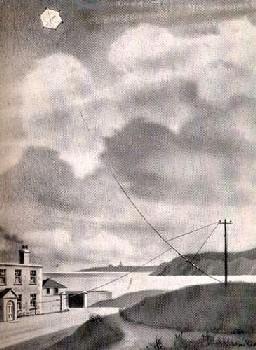
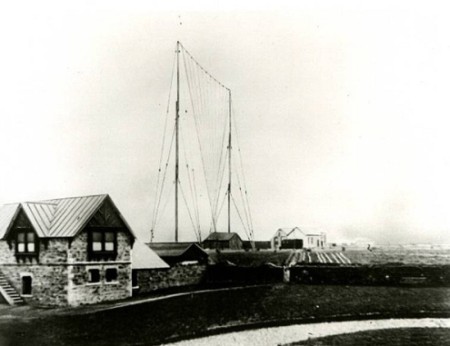
The history of the wireless communication started with the discovery of a coherer which is an original detection device for the detection of electromagnetic waves in long-wave frequency band. To the coherer, a long-wave wire antenna was connected. In first experiments, the wire antenna was unmatched. When Marconi implemented first tests in 1896, he used the transmatched long-wire hang up on kite (see fig. 10.1A.1). Consequently, he used wire antenna with the defined length depended on the wavelength. For the first radio connection across the Atlantic Ocean, the quarter-wavelength monopole was used (see fig. 10.1A.2).
After World War II, the antennas with a single fed element and parasitic elements were designed. Yagi-Uda antenna is the most famous antenna of this type. Yagi-Uda antenna was originated in 1926, and was practically used after World War II. The microwave circuits shifted the operation frequencies to higher bands. The wavelength of electronics was decreased, and new possibilities of the design were created. In the following chapters, wire antennas, which are frequently used in various communication applications, are described. |
 PDF version